

Digital Health Canada conducts nationwide environmental scan of Ai-driven clinical initiatives in healthcare delivery
The AI in Action: Transforming Clinical Care Across Canada CHIEF Executive Forum Working Group, championed by Dr. Tania Tajirian, Chief Health Information Officer and Chief of Hospital Medicine at the Centre for Addiction and Mental Health (CAMH), has completed a first-of-its-kind environmental scan of artificial intelligence driven clinical initiatives in Canadian healthcare delivery. The scan provides a snapshot of verifiable, publicly available activity and establishes a baseline for ongoing monitoring.
Purpose
The scan catalogues initiatives across provinces, territories, care settings, technology types, and stages of deployment. It is intended to help leaders see where AI adoption is visible, and where opportunities and gaps may exist. It is not a complete census of all work underway.
Methodology
This environmental scan was conducted by a group of emerging professionals and Masters of Health Informatics volunteers and relied exclusively on publicly available sources, including media reports, health system announcements, vendor publications, and outputs from national funding programs. Each province and territory was reviewed individually using a standardized framework to support comparability. All entries were verified for correctness prior to inclusion and pivot tables were used to draw key insights and generate counts across standardized categories.
Limitations
The scan is based on information available through health system announcements, funder databases, and media. Undisclosed pilots or internal deployments are not captured, which may underrepresent the full scope of AI activity.
Hospitals and health system level deployments dominate public reporting. Primary care, long term care, community health, and Indigenous or remote settings are much less visible.
Some entries reflect vendor or funder announcements without clear evidence of sustained clinical use.
Because many initiatives are in pilot stage, some may have already scaled or been discontinued, and new initiatives may have emerged since the scan’s close.
Key Insights
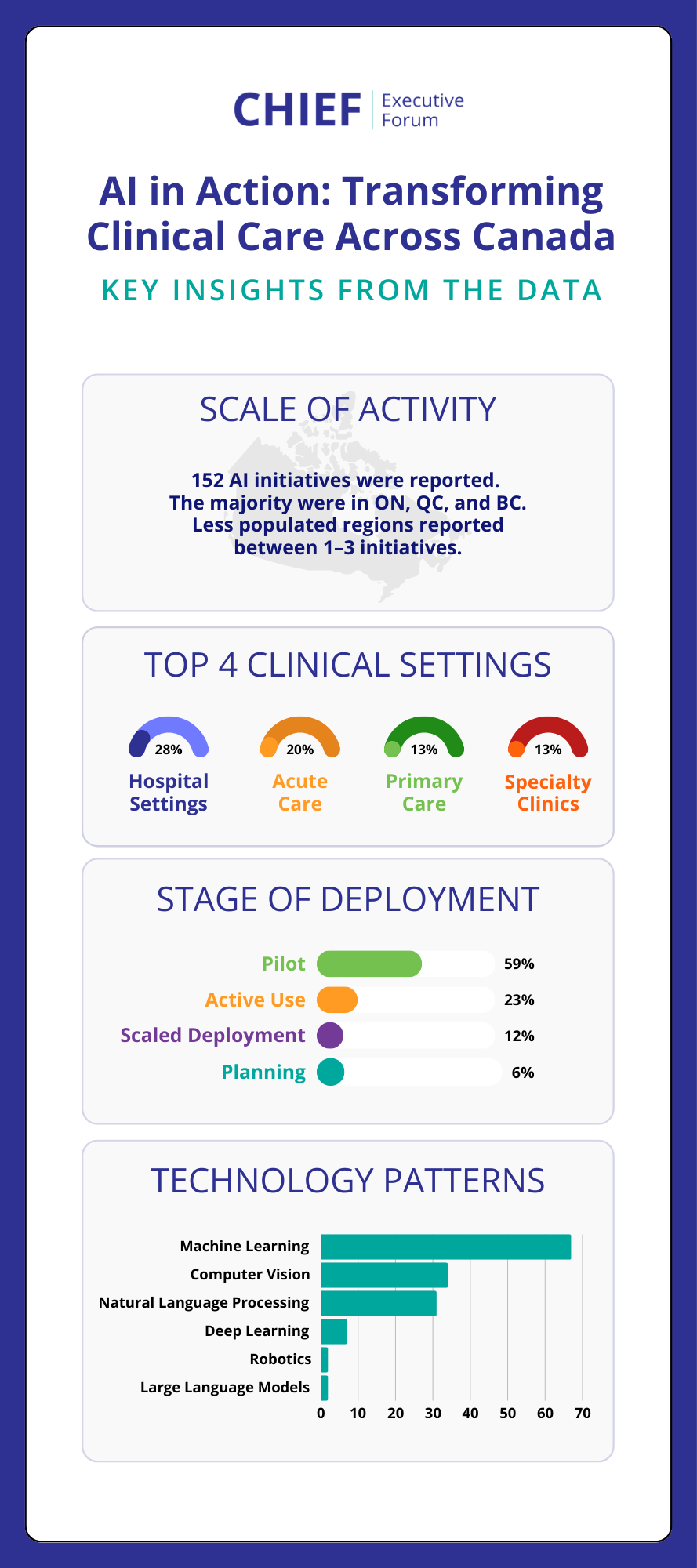
Larger provinces, including Ontario, Quebec, and British Columbia, account for most initiatives in the scan. Smaller provinces and territories often report only one to three.
AI initiatives were most commonly deployed in hospital settings, followed by acute care, primary care, specialty clinics, health systems, ambulatory care centres, and diagnostic imaging. Community health, long term care, public health, and remote care remain comparatively rare, indicating an imbalance across care environments.
Machine learning was the most frequently used AI technology, particularly for prediction and triage. Computer vision was concentrated in diagnostic imaging and endoscopy. Natural language processing appeared most often in AI scribes and chatbots. Deep learning, large language models, and robotics were less frequently documented.
The majority of initiatives remain in pilot stage. Some are reported as in active use and a smaller number as scaled deployment or system wide.
Keeping the Scan Current
This scan is a living resource. The original data set included 152 initiatives and has grown to 174, with new initiatives submitted regularly. Healthcare providers and organizations are invited to share details of their clinical AI initiatives to help keep the database accurate and current. Submissions can be sent to [email protected].
Building a National ROI Framework
The AI in Action Working Group will continue to build on this work. Stage two focuses on designing a framework and practical toolkit for forecasting, measuring, and communicating the value, impact, and return on investment of clinical and operational AI tools.
At present, there is no standardized Canadian model for evaluating the ROI of AI tools in healthcare. Metrics are inconsistent, baselines are rarely captured, and smaller organizations may lack the analytic capacity to justify or sustain AI investments. This project aims to address that national gap by producing a flexible, evidence-based framework to assess both tangible value, such as financial and operational metrics, and intangible value, such as clinical, experiential, and workforce impacts. The framework will define minimum required components and optional flexible components that can be adapted based on local capacity and maturity.
By establishing a shared national view of clinical AI activity and creating practical tools for evaluating impact, the AI in Action Working Group is helping build the foundations for responsible, evidence informed AI adoption across Canadian healthcare. As this work progresses, collective visibility and shared evaluation tools will be essential. The Working Group invites organizations across Canada to participate, contribute, and help shape a clearer and more consistent understanding of how AI is transforming clinical care.
View more resources.