


Homira Osman
Vice-President of Research, Public Policy and Programs, Muscular Dystrophy Canada

Dr. Hanns Lochmüller
Neurologist, Ottawa Hospital & Senior Scientist, CHEO Research Institute
Health Canada approval confirms a therapy is safe and effective, however, this does not guarantee public coverage. For Canadians living with Duchenne muscular dystrophy, that gap can have lasting consequences.
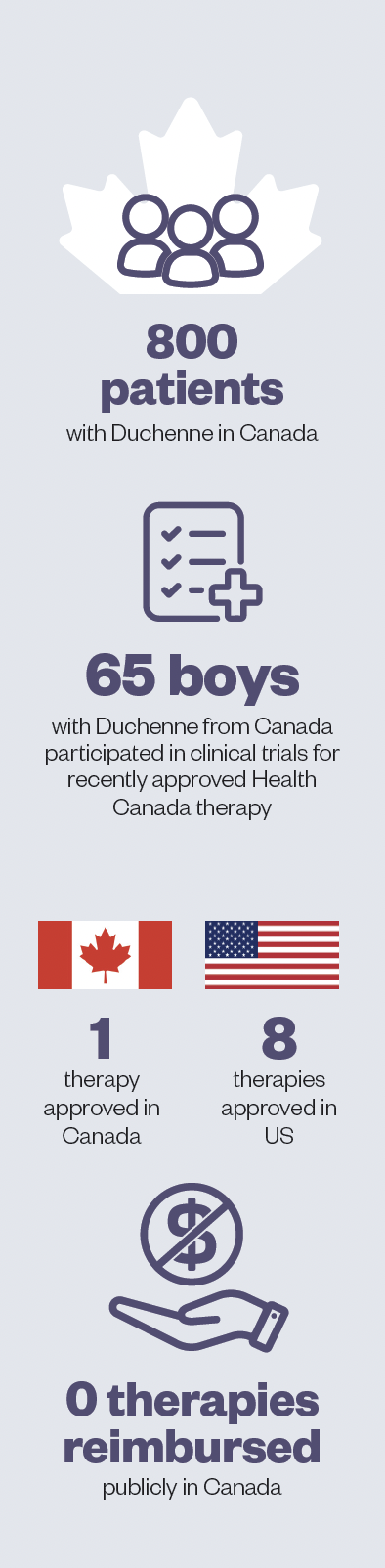
Canadian investigators, clinical sites, and families helped advance the evidence for the first and only therapy specifically approved for a neuromuscular disorder, Duchenne muscular dystrophy in Canada through four clinical trials at five Canadian sites.
While some patients have received the therapy through clinical trials since 2016, it is still not accessible through drug plans, despite Health Canada approval. This is a stark example of the disconnect between innovation and timely access to treatment in this country.
In fact, according to the Canadian Health Policy Institute, Canadians waited an average of four years after Health Canada approval for access to new drugs at the provincial level. This was 2.5 years longer than Americans covered by Medicare and 2.2 years longer than publicly insured Europeans.
Health Canada approval means the therapy meets the standards for safety, efficacy, and quality. But it does not mean a treatment is covered by public drug plans. For families living with Duchenne muscular dystrophy, that distinction can be devastating.
“This is where families are often caught off guard,” says Homira Osman, PhD, vice-president, research, public policy and programs at Muscular Dystrophy Canada. “Health Canada approval sounds like access, but for families it may mark the beginning of another long wait. Patients and families contact Muscular Dystrophy Canada and their healthcare teams with renewed hope, only to learn that the therapy may still be available solely through private insurance, a manufacturer-supported program or a clinical trial.”
Health and financial costs for patients, families, and the healthcare system
For progressive diseases such as Duchenne, time matters. “When treatment access is delayed, it can lead to earlier loss of independence and greater disability,” says Dr. Hanns Lochmüller, a neurologist at Ottawa Hospital and senior scientist at Children’s Hospital of Eastern Ontario (CHEO) Research Institute. Delays can mean more fatigue, difficulty climbing stairs, a greater need for support, or ageing out of treatment eligibility if the provinces decide to only reimburse treatments for pediatric patients.
Delayed treatment initiation also affects families. Parents may reduce work hours or leave jobs to provide care, while covering costs for travel, mobility aids, and accessible transportation. The healthcare system may face increased demand for specialist care, emergency services, mobility devices, and home care services.
“We should not assume that every cost would be avoided through treatment. But it is also inappropriate to assess only the price of the drug while ignoring the potential health, family, and system costs associated with disease progression,” Osman says.
Canada cannot lead in research while lagging in access
Delays can also affect Canada’s reputation as a destination for research and clinical trials.
While Canadians contribute to generating evidence used around the world, companies may hesitate to initiate new trials and launch treatments in a country with an unreliable path to patient access.
After Health Canada approval, a therapy must go through several additional steps before patients can access it through public drug plans. These include evidence reviews, price negotiations, and separate coverage decisions by provinces and territories. As a result, approval does not automatically mean access.
Osman says planning for access should begin before a therapy is approved rather than afterward. “Health Canada, health technology assessment bodies, the provinces, clinicians, patients and manufacturers should identify evidence requirements and implementation needs while clinical trials are still underway.”
Rare-disease patient populations are small, and long-term evidence can take years to accumulate. But uncertainty should be viewed alongside what is known about disease progression. In diseases like Duchenne, slowing down decline or helping a patient maintain function can be meaningful, even without dramatic improvements.
Uncertainty should be managed, not used as a reason for indefinite waiting
Canada already has tools that can help address these evidence gaps. Muscular Dystrophy Canada’s newly launched Neuromuscular Disease Real-World eXperience Registry (NMD-RWx), the first national, patient-powered registry for people with neuromuscular disorders, can collect information on who is affected, where they live, the treatments they receive, their health outcomes and quality of life, and their access to care, equipment and supports.
Dr. Lochmüller says patient registries such as the NMD-RWx and the Canadian Neuromuscular Disease Registry provide a practical solution by allowing access to treatment while monitoring results. “There should be mandatory collection of real-world data through these registries. Reimbursement could be dependent on long-term efficacy and safety.”
Osman says, “Canadians are not asking for every therapy to be funded automatically or at any price. They are asking for timely, transparent and evidence-informed decisions and for uncertainty to be actively managed through real-world evidence and ongoing evaluation, rather than used to justify indefinite delay.”
Canada has made a commitment to improve access to drugs for rare diseases. Policymakers must prioritize reducing delays between regulatory approval and patient access, because every month of waiting can mean irreversible loss of function for children with Duchenne muscular dystrophy.
Sign the petition.
This article was made possible with support from Kye Pharmaceuticals.