
This novel treatment takes research from discovery to impact, saving patient from life-altering skin grafts.
A holiday mixer for fraternity and sorority members near London’s Western University last December turned into a terrifying scene when a fire broke out, sending five young women to hospital.
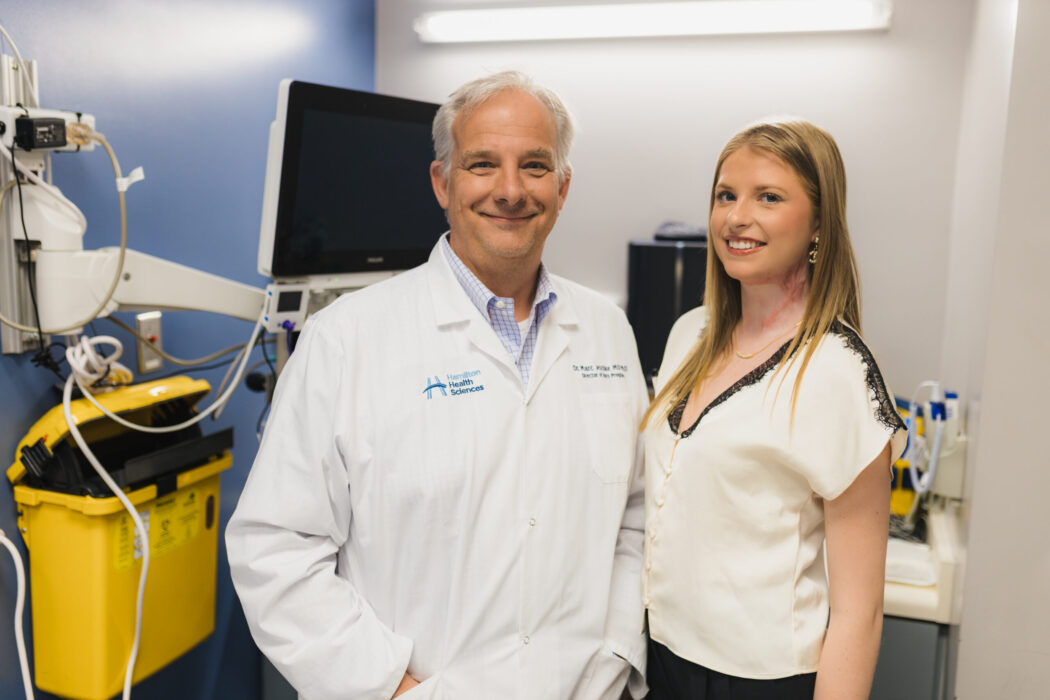
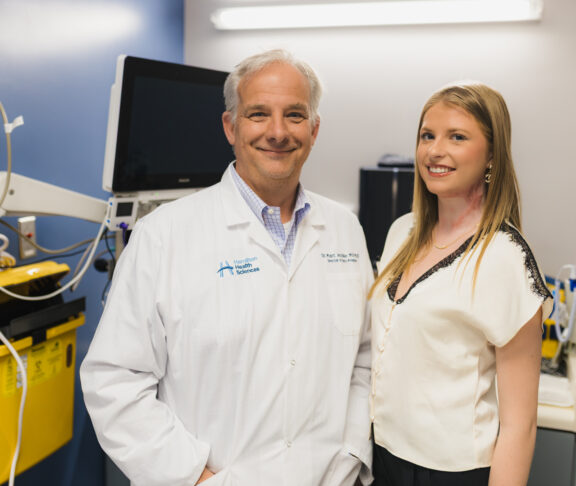
Kaitlin Jeffrey, 18, of Toronto, was the most seriously injured, with deep burns to her face, neck, and body. She was transferred to Hamilton Health Sciences’ (HHS) Hamilton General Hospital, home to one of Ontario’s two regional burn centres.
“In Hamilton, the care was amazing,” says Jeffrey. “Each and every member of the burn team has had a huge impact on my life.”
Dr. Marc Jeschke, a globally recognized burn surgeon and medical director for the regional burn program, was determined to restore Jeffrey’s face and neck as closely as possible to normal. His innovative plan centred on a novel, world-first biological treatment using exosomes that produced exceptional results, particularly on Jeffrey’s face.
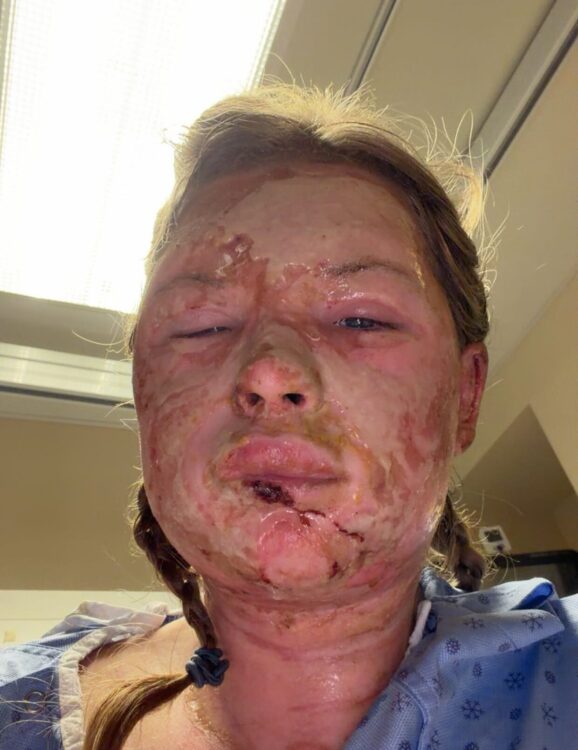
Saving face
Jeffrey suffered deep partial- and full-thickness burns to her face that most likely would have required skin grafts. Her neck fared worse, with full thickness burns. Worldwide, the current standard treatment for deep burns is skin grafting surgery, but it leaves skin with scars and a patch-like appearance.
The exosome treatments are extremely safe, and the results were absolutely remarkable.
“My vision for Kaitlin was to avoid skin graft surgery to her face and neck at any cost,” says Dr. Jeschke, who is also HHS’s vice-president of research and innovation and chief scientific officer and a professor of surgery at HHS’s key academic partner, McMaster University. He has been at the forefront of new and emerging burn research and treatments for more than two decades.
Dr. Jeschke asked Jeffrey if she might be interested in a never-before-tried burn treatment on her face and neck using exosome injections as an alternative to grafting. Exosomes are tiny particles released by cells that carry signals from one cell to another to help coordinate rapid healing and tissue repair and reduce inflammation. With exosome therapy, these particles are collected, typically from lab-grown cells, and injected into the injured areas to rapidly accelerate healing.
An innovative plan
Tapping into years of research, Dr. Jeschke felt that exosome therapy was Jeffrey’s best option. Exosomes had been studied for years as part of burn research, but not yet in humans. However, some human clinical trials have explored exosomes for different types of wound healing, with promising results.
Dr. Jeschke’s team became the first in the world to perform this treatment on a burn patient. “The exosome treatments are extremely safe, and the results were absolutely remarkable,” says Dr. Jeschke. “You can’t tell by Kaitlin’s face that she once suffered burns.”
Jeffrey’s neck still has active scarring — the phase of healing when a scar is still developing and can appear red and raised before settling into its final form. She continues to get platelet-rich plasma and laser treatments at HHS to treat that area.
With further research, Dr. Jeschke hopes the exosome treatment he used to help Jeffrey avoid grafting surgery will become the standard of care in Canada.
Learn more about HHS’s latest innovations at hamiltonhealthsciences.ca.