

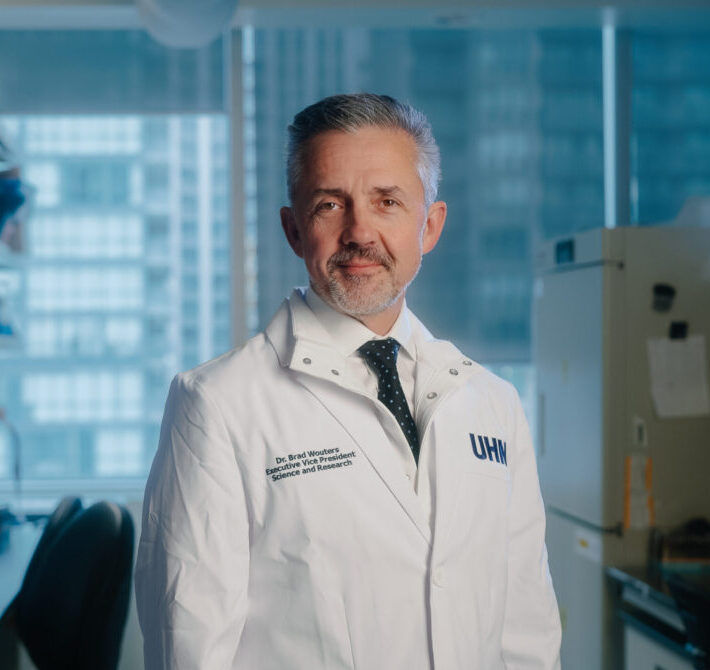
Brad Wouters
Executive Vice-President of Science and Research, University Health Network (UHN)

Dr. Lillian Siu
Senior Clinician Scientist, UHN’s Princess Margaret Cancer Centre & Scientific Lead, Peter Gilgan Centre for Early Cancer Detection Research at Princess Margaret
UHN is leading the way in next-generation early cancer detection research, innovation, commercialization, and talent recruitment to drive both patient outcomes and national economic growth.
At University Health Network (UHN), scientific discovery is being transformed into real-world impact for patients—and economic value for Canada. Through commercialization, UHN innovations are becoming new diagnostics, treatments and technologies, improving outcomes for more than 1.25 million patients.
“Investing in a research-based economy means investing in people and ideas that can change what’s possible in medicine,” says Dr. Brad Wouters, Executive Vice President, Science and Research, UHN. “The result is two-fold: better outcomes for patients and a thriving knowledge-based economy with a significant economic footprint for Canada.”
Advancing next-generation cancer detection
Researchers led by Dr. Lillian Siu at UHN’s Princess Margaret Cancer Centre are working to answer this question, through studies such as SHERLOCK, which uses blood tests to detect molecular residual disease (MRD), traces of circulating tumour DNA that may be detected in the blood before cancer is visible on CT or MRI scans or on physical examination. “We now have highly sensitive technology and increasing scientific knowledge to detect MRD in the blood,” says Siu.
For many cancer patients, one of the most important questions begins after definitive (or curative) treatment ends: Is the cancer truly gone or will it come back?
Supported by a $50 million gift from the Peter Gilgan Foundation, SHERLOCK will enroll 7,000 patients over 5 years, making it one of the largest MRD studies globally, combining philanthropy, clinical research, and industry collaboration to enable earlier, more personalized care. This study is being launched by the Peter Gilgan Centre for Early Cancer Detection Research.
“For patients who have already endured definitive cancer treatment, the question that often lingers is: Is the cancer truly gone?” said Siu. “Our hope is that studies like SHERLOCK will bring us much closer to answering that question with confidence and ultimately prevent cancers at high risk of relapse from returning.”
Turning discoveries into real-world impact
SHERLOCK is enabled by UHN’s world-leading expertise in cancer research, genomics, computational biology, and clinical trials.
Its philanthropic foundations, The Princess Margaret Cancer Foundation and UHN Foundation, help to fund early discoveries across a wide range of diseases. Industry partnerships help scale these discoveries, while commercialization initiatives aim to bring this to patients globally while generating value and impact in Canada.
“We have a very supportive community that shares our ambition of being a global leader in innovation and research,” says Wouters. “The federal and provincial governments are important funders, and we also partner with industry to bring clinical trials and other funding here.”
These partnerships accelerate how quickly breakthroughs turn into real-world care. This reflects a broader model of innovation, where philanthropy enables early discovery; clinical research generates evidence, and industry and commercialization partners help translate that science into scalable tools that reach patients globally.
UHN is advancing its talent strategy through Canada Leads, an initiative designed to attract researchers who can accelerate discovery and translate innovation into real-world impact, including commercialization.
“We’ve seen tremendous momentum and impact and have already recruited 80 researchers in the first nine months of the program,” says Wouters. “Our focus is on early-career talent and individuals who can help translate research into meaningful health, economic, and commercial impact.”
Canada’s research institutions, including UHN, are among the world’s best. As global competition intensifies, continued investment will be critical to translating discovery into better care and economic impact. “Now there is an opportunity to invest in and leverage these assets,” says Wouters.
Canada’s future as a science and innovation leader depends on its ability to attract, retain, and scale world-class talent while accelerating scientific discovery into real-world patient and economic impact. Learn more at uhn.ca.