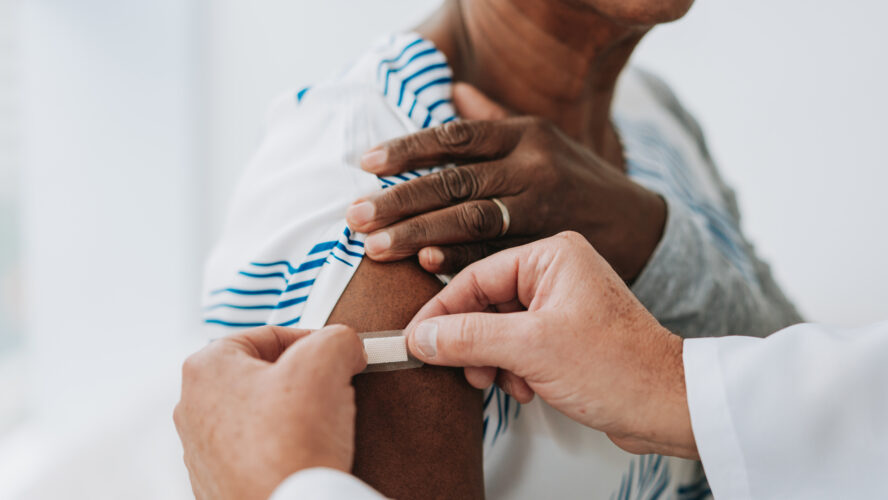
Invasive pneumococcal disease can cause severe illness and even death, especially in older Canadians. Taking preventative measures is important.
Both pneumococcal pneumonia and invasive pneumococcal disease can cause serious complications in older adults,1 including cardiac events.2 Knowing the risks and how to help protect yourself or your loved ones is important.
Invasive pneumococcal disease (IPD) occurs when the streptococcus pneumoniae bacteria — which is responsible for pneumococcal pneumonia and typically causes infections of the ears, sinuses, or lungs3 — invades the bloodstream and spreads to the brain, joints, heart muscle, or other areas,4 leading to serious conditions like meningitis or sepsis.5
“IPD is far less common than bacterial pneumonia, but tends to be more severe with worse outcomes,” says Dr. Ronald Grossman, a practising respirologist, Professor of Medicine at the University of Toronto, and former Chief of Medicine at Credit Valley Hospital.
Know the risks
“If someone aged 65-plus is hospitalized with community-acquired pneumonia, the 30-day mortality rate is about 7.6 per cent,”6 says Dr. Grossman. About 25 to 30 per cent of patients with pneumococcal pneumonia will develop bacteremia or another form of IPD.7 IPD symptoms include fever, stiff neck, headache, nausea, joint pain, and chills.8
Those most at risk include older adults,9 young children,10 immunocompromised patients,11 and people with chronic conditions like COPD, heart disease, or diabetes.12
Adverse cardiac events are one of the biggest risks.13 “More people admitted to hospital with community-acquired pneumonia will die of cardiac complications than of the pneumonia itself,”14 says
Dr. Grossman.
With IPD, helping to prevent it is preferable to treatment. “Antibiotic therapy may not be enough,” says Dr. Grossman. “We’ve bad outcomes despite therapy.”
IPD is far less common than bacterial pneumonia, but tends to be more severe with worse outcomes.
Help protect yourself
The pneumococcal vaccine is an effective way to help prevent IPD.15 However, as with all vaccines, 100 per cent protection may not be guaranteed and adverse reactions may occur. Vaccines do not treat IPD and its complications once it develops.
Dr. Grossman notes that the pneumococcal vaccine is important for older adults to receive, along with other respiratory vaccines like those for COVID, influenza, and RSV.16
Unfortunately, Canada lags behind its vaccination coverage goals: 2023 stats show that only 55 per cent of adults aged 65-plus received one dose of pneumococcal vaccine, versus the goal of 80 per cent.17
A tailored approach to vaccination is wise. Different pneumococcal vaccines exist.18
“The pneumococcus has about 100 serotypes,”19 explains Dr. Grossman. Different vaccines target different serotypes, or strains, of the bacterium.20
Dr. Grossman recommends speaking to your health care practitioner about which pneumococcal vaccine might be best for you, and notes that equitable access to vaccination across Canada is essential. Not all of the available pneumococcal vaccines are currently available in all provinces and territories.21
For more information on pneumococcal vaccinations, speak to your health care provider.
This article was made with support from Merck Canada.


- https://www.canada.ca/en/public-health/services/immunization/vaccine-preventable-diseases/invasive-pneumococcal-disease.html
- https://www.atsjournals.org/doi/10.1164/rccm.201701-0104OC
- https://www.canada.ca/en/public-health/services/immunization/vaccine-preventable-diseases/invasive-pneumococcal-disease.html
- https://www.publichealthontario.ca/en/Health-Topics/Immunization/Vaccine-Preventable-Diseases/IPD
- https://www.publichealthontario.ca/en/Health-Topics/Immunization/Vaccine-Preventable-Diseases/IPD
- https://pmc.ncbi.nlm.nih.gov/articles/PMC5328220/#:~:text=The%20reported%20mortality%20of%20CAP,with%20mortality%20in%20older%20patients.
- https://www.regionofwaterloo.ca/en/health-and-wellness/resources/Documents/IPD-Fact-Sheet.pdf
- https://bchu.org/public-health-topic/infectious-disease/fact-sheets/pneumococcal-infections/
- https://www.regionofwaterloo.ca/en/health-and-wellness/resources/Documents/IPD-Fact-Sheet.pdf
- https://www.regionofwaterloo.ca/en/health-and-wellness/resources/Documents/IPD-Fact-Sheet.pdf
- https://academic.oup.com/cid/article-abstract/62/2/139/2462731?redirectedFrom=fulltext
- https://pmc.ncbi.nlm.nih.gov/articles/PMC4602259/
- https://pmc.ncbi.nlm.nih.gov/articles/PMC9695472/
- https://pmc.ncbi.nlm.nih.gov/articles/PMC9695472/
- https://www.canada.ca/en/public-health/services/publications/healthy-living/canadian-immunization-guide-part-4-active-vaccines/page-16-pneumococcal-vaccine.html
- https://www.nia.nih.gov/health/immunizations-and-vaccines/vaccinations-and-older-adults
- https://www.canada.ca/en/public-health/services/immunization-vaccines/vaccination-coverage/adult-national-immunization-coverage-survey-2023-results.html
- https://www.canada.ca/en/public-health/services/publications/vaccines-immunization/national-advisory-committee-immunization-statement-recommendations-use-pneumococcal-vaccines-adults-pneu-c-21.html
- https://publications.ersnet.org/content/erj/43/2/331#:~:text=However%2C%20there%20is%20a%20lot,clinical%20phenotype%20in%20individual%20patients.
- https://www.canada.ca/en/public-health/services/immunization/vaccine-preventable-diseases/invasive-pneumococcal-disease/health-professionals.html
- https://www.immunize.ca/sites/default/files/Resource%20and%20Product%20Uploads%20(PDFs)/Products%20and%20Resources/Pneumococcal/Pocket%20Guide/2023/pneumococcal_pocketguide_web_e.pdf
